 Panacea Bio Chem · Technology Record

TgShift™ — short for Glass-Transition Temperature Shift — is a sublimation-stage lyophilization technology that raises a formulation's glass-transition temperature Tg′1. Because an amorphous freeze-dried cake collapses the moment its temperature climbs above Tg′, conventional practice keeps the product cold and dries it slowly. TgShift lifts the ceiling instead: with Tg′ raised, the shelf can run warmer and the chamber can sit at higher pressure — both of which speed sublimation — while the cake stays glassy and rigid. A software governor holds the product just below the raised Tg′ throughout primary drying, in step with the S3Pulse™ control algorithm →. The result is faster, more robust primary drying and a denser, more elegant cake. TgShift is one of four proprietary technologies built into Lyochrysalis™, Panacea Bio Chem's integrated lyophilization platform — working shoulder to shoulder with LyoLevit™, Cryolapse™ and DiastolVAC™, all orchestrated by S3Pulse. In the finished cake that teamwork is felt as longer shelf life, cleaner reconstitution, and preserved bioavailability and binding affinity.
1What the glass transition actually is
Freeze-drying does not simply "dry" a solution — it first freezes it, then removes the ice by sublimation2, the direct solid-to-vapour jump. Most peptide and protein formulations do not crystallise neatly. Instead, as water freezes out, the remaining sugars, salts and molecules concentrate into a thick, amorphous (glass-like) syrup wrapped around ice crystals — the freeze-concentrate.
That glass has a personality. Below a certain temperature it is hard and brittle, like a boiled sweet; warm it past a threshold and it softens into something that flows, like warm toffee. That threshold is the glass-transition temperature. For a maximally freeze-concentrated solution it has its own symbol, Tg′1 ("T-g-prime"). Think of it as the exact warmth at which a rigid glass turns rubbery.
During primary drying, the porous cake is only held up by that glass. Keep the product below Tg′ and the walls stay rigid as the ice leaves, so a beautiful open lattice remains. Let the product drift above Tg′ and the glass flows — the pores close, the structure slumps, and the cake collapses.
2Why Tg′ is the whole game in primary drying
Cake collapse is not just an appearance problem. A collapsed cake traps residual moisture, dissolves slowly and unevenly on reconstitution, and can lose the structural protection that keeps a fragile peptide folded. So formulators live by an iron rule: hold the product temperature below Tg′ throughout primary drying3.
The trouble is that Tg′ for common protectants is very cold. Trehalose sits near −29 °C and sucrose near −32 °C4. To stay under that, the shelf must be run cold and the chamber pressure kept low — and a cold, low-pressure product sublimes slowly. That is the frontier every lyophilization scientist runs into: the cake's own glass ceiling forces long, expensive drying cycles, sometimes many hours to a day per batch. Push the shelf warmer to save time and you risk collapse; stay cold to be certain and you pay in hours, energy and throughput.
3The TgShift principle — raise the ceiling, don't chill the room
Everyone else's instinct is to chill the room: keep the product cold enough to stay under a fixed Tg′. TgShift inverts the idea. Instead of forcing the product down to meet a low ceiling, it raises the ceiling to meet a warmer, faster process.
Through Panacea's formulation approach, the glass-transition temperature Tg′ of the freeze-concentrate is shifted upward. With a higher Tg′, the same cake stays glassy and rigid at a warmer shelf temperature and a higher chamber pressure than it ever could before. Warmer product and higher pressure both drive faster sublimation, so primary drying finishes sooner — and because the glass never softens, the cake stays open, dense and elegant rather than slumped. It is a quiet, elegant move: change the material's ceiling, and the whole cycle gets faster without ever flirting with collapse.
The shift is worked right where it counts — at the neck of the cartridge. There, finely governed thermal energy together with radio-frequency and ultrasonic control conditions the freeze-concentrate so its glass holds firm at a warmer, faster set point. Acting at the neck lets TgShift steer the cake's glassy behaviour precisely, cartridge by cartridge, rather than leaning on shelf temperature alone — a formulation change and a process change working as one.
4Panacea's contribution
Panacea Bio Chem researches the glass-transition frontier of freeze-drying as an ongoing programme. Its contribution with TgShift is a sublimation-stage system that deliberately raises the formulation's Tg′ — rather than accepting the low, fixed collapse ceiling of standard sugar glasses — so that primary drying can be run warmer and at higher pressure without the cake losing its structure. The upward Tg′ shift is achieved through Panacea's own formulation chemistry and is held just below its new, raised value in real time by a software governor working with the S3Pulse control algorithm. Together they turn a warmer, faster cycle from a collapse risk into a repeatable process that still yields a dense, well-formed cake. The exact magnitude of the shift, the excipient system that produces it, and the governor's control parameters remain proprietary to Panacea Bio Chem.
5The governor — staying just under the raised ceiling
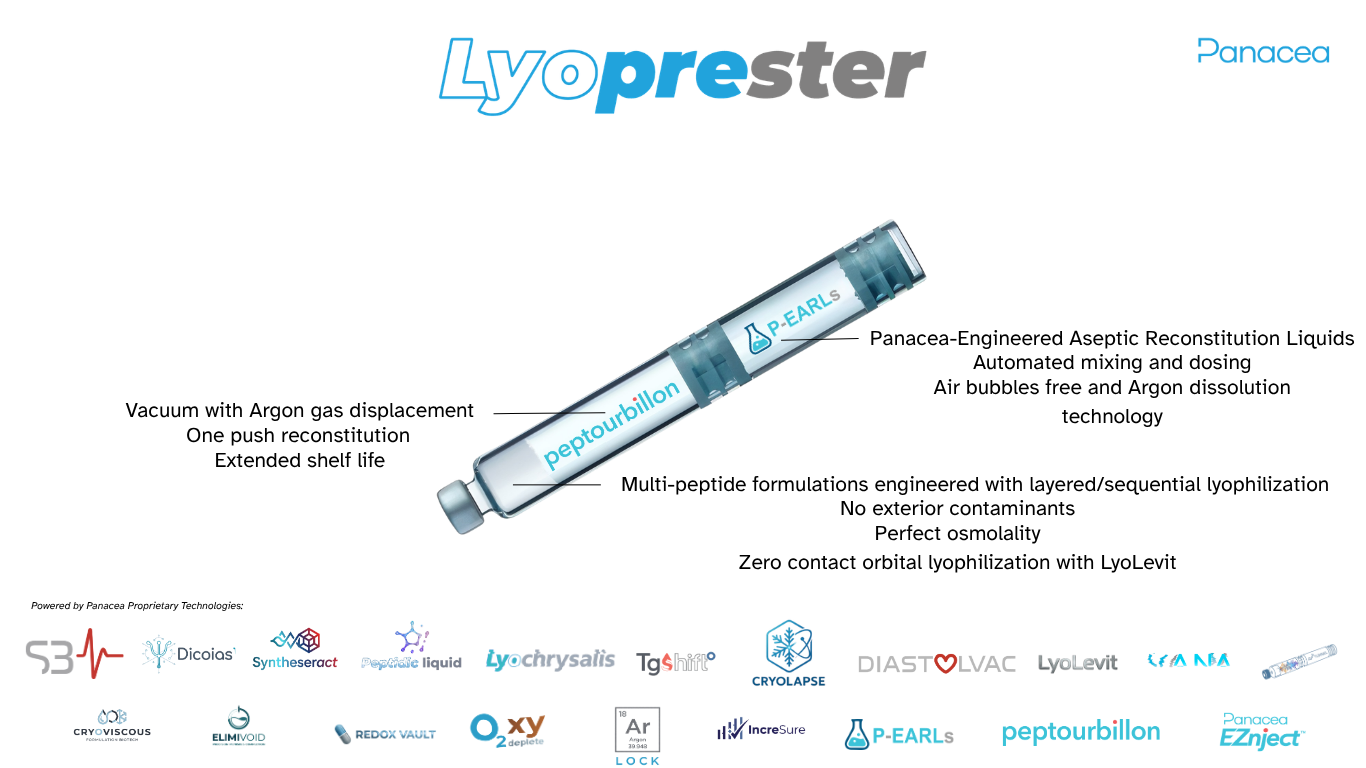
Raising Tg′ opens a warmer operating window, but a window still has an edge. The product temperature must ride just below the new, higher Tg′ for the whole of primary drying — high enough to dry fast, never so high that the glass softens. That margin is held by a software governor paired with the S3Pulse™ control algorithm →, which reads temperature and pressure in real time and modulates shelf heat and chamber pressure to track the raised Tg′ as the drying front recedes. TgShift is the material change; S3Pulse is the hand that keeps it on the edge. The technology sits within Panacea's wider lyophilization stack — alongside methods such as Cryolapse™, the gentle cryogenic pressure collapse → and the self-reconstituting Lyoprester® cartridge →.
6Inside Lyochrysalis — TgShift and its sibling technologies
TgShift does not act alone. It is one of four proprietary technologies built into Lyochrysalis™, Panacea Bio Chem's integrated lyophilization platform. Each addresses a different corner of the same problem — turning a fragile peptide solution into a dense, stable, beautifully soluble cake — and all four move in concert under the S3Pulse™ control algorithm →, which reads temperature and pressure in real time and keeps every technology on its ideal path.
| Technology | What it does in Lyochrysalis | What the cake gains |
|---|---|---|
| TgShift™ | Raises Tg′ via formulation plus thermal/RF/ultrasound conditioning at the cartridge neck | Warmer, faster drying with a glassy, non-collapsed matrix |
| LyoLevit™ | Thermal decoupling / levitation so heat reaches each cartridge on its own terms | Even, gentle drying free of shelf hot- and cold-spots |
| Cryolapse™ | Gentle cryogenic pressure-collapse that sublimates ice softly, surfactant-free | An open, low-stress pore network — kind to fragile folds |
| DiastolVAC™ | Biomimetic vacuum pulsation that shapes the pressure curve to the cake's sublimation kinetics | Steady sublimation without stalling or defect formation |
| S3Pulse™ | The orchestrator — coordinates temperature, vacuum and cycle timing across all of the above | A repeatable cycle that holds every technology on its edge |
Where TgShift keeps the glass rigid at a warmer set point, LyoLevit makes sure the warmth arrives evenly, Cryolapse keeps the pore structure open and gentle, and DiastolVAC keeps the vapour leaving smoothly — while S3Pulse conducts the whole ensemble. For heavy-loaded peptide cartridges the platform can also open a reconstitution channel through the cake's dense middle, easing the return to liquid when the cartridge is later dissolved with its matched Lyoprester® diluent.
What TgShift delivers in the finished cake
- Longer shelf life — a denser, higher-Tg′ glass with less residual moisture keeps the peptide immobilised and quietly stored for longer, resisting the slow molecular drift that shortens a cake's usable life.
- Better reconstitution — a cake that stayed open and glassy (never slumped) wets and dissolves cleanly and evenly, so the cartridge returns to a clear solution quickly and completely.
- Preserved bioavailability & binding affinity — because the peptide is cradled in a rigid glass rather than pushed through a rubbery, collapsing phase, its fold and surface chemistry are held intact — so the molecule that comes back out still meets its target the way it should.
This is the thread that runs through every Panacea technology and every cartridge Bogdan Dicoias designs: protect the molecule from freeze to fill to final dose, so that what the patient receives is the peptide exactly as intended.
7Comparison — fixed ceiling vs. shifted ceiling
| Dimension | Conventional primary drying | TgShift |
|---|---|---|
| Glass-transition ceiling (Tg′) | Fixed, low (sugar-glass limit) | Raised — warmer window opens |
| Shelf temperature | Held cold to stay under Tg′ | Warmer, still below raised Tg′ |
| Chamber pressure | Kept low | Higher — faster sublimation |
| Primary-drying time | Long (hours to ~a day) | Shortened |
| Cake structure | Collapse risk if pushed warmer | Dense, open, elegant |
| High-solids / heavy loads | Hard — collapse-prone | More workable window |
The gain is compounding: a warmer shelf and a higher pressure each raise the sublimation rate, so shifting Tg′ upward buys time on two axes at once — while the raised ceiling keeps the cake out of the rubbery, collapse-prone state entirely.
8Reference glass-transition data
Typical Tg′ values for common lyophilization protectants (literature figures; exact values depend on concentration and method):
| Protectant | Approx. Tg′ | Role in the cake |
|---|---|---|
| Trehalose | ≈ −29 °C | Amorphous glass former, protein cradle |
| Sucrose | ≈ −32 °C | Amorphous glass former |
| Sorbitol | ≈ −44 °C | Low-Tg′ plasticiser (lowers the ceiling) |
| Dextran / polymers | Higher (varies) | Raise Tg′ but slow water removal |
The table shows the frontier plainly: the best protein-protecting sugars have the lowest Tg′, forcing cold, slow drying. TgShift's purpose is to lift that ceiling without giving up the glass that protects the peptide.
9Where a raised Tg′ hits hardest
- Faster, cheaper cycles — shorter primary drying means more batches per dryer, lower energy per vial, higher throughput.
- Heat-sensitive biologics dried warmer — antibodies, enzymes and fragile peptides can be dried at a warmer, faster shelf setting while the cake stays glassy and structurally intact.
- High-solids & heavy-load formulations — concentrated, high-fill cakes that normally collapse gain a workable drying window.
- Thermostable field vaccines — formulations intended to survive warm-chain storage benefit from a denser, higher-Tg′ glassy matrix.
- Dual-chamber and self-reconstituting formats — dense, well-formed cakes dissolve cleanly, suiting cartridges such as Lyoprester® →.
These application fields double as an R&D map: the biggest wins are wherever collapse currently forces a slow, cold, cautious cycle — that is exactly where lifting the ceiling pays off most.
10Tg′, Tg and Tc — three temperatures, three jobs
Tg′ ("T-g-prime") is the glass-transition temperature of the maximally freeze-concentrated solution — the point below which the unfrozen matrix left behind by ice crystallisation holds as a rigid glass. It is the temperature budget of primary drying: product held below Tg′ keeps a structured cake; product pushed above it turns rubbery and collapses.
Tg′ is not Tg — frozen concentrate vs dried cake
One excipient carries two very different glass-transition numbers, and mixing them up is the most common reading error in freeze-drying literature. Tg′ describes the frozen concentrate and limits the drying step; Tg describes the dried cake, with the water already removed, and governs storage. The dried-state values sit far above room temperature — which is why a glassy cake stores well — while the frozen-state values sit tens of degrees below zero, which is why primary drying has to start cold.
| Quantity | State it describes | Typical values | What it governs |
|---|---|---|---|
| Tg′ | Maximally freeze-concentrated solution (frozen) | Trehalose ≈ −29 °C · sucrose ≈ −32 °C · sorbitol ≈ −44 °C | Drying — the primary-drying ceiling of §2 |
| Tg | Dried cake (water removed) | Trehalose ≈ +107 °C · sucrose ≈ +60 °C5 | Storage — shelf stability of the finished cake |
Tc is not Tg′ — the margin that runs the cycle
The collapse temperature Tc is where the drying cake visibly loses structure, and in amorphous formulations it sits above Tg′ — commonly by only about 2–5 °C in sugar-based systems, while polymer-rich formulations run far wider: dextran ladders show collapse temperatures up to roughly 20 °C above comparable sugar glasses.67 Process design therefore holds the product temperature a few degrees below Tc — on the order of 2–5 °C depending on cycle length.8 The distinction matters for reading TgShift: running warmer inside a margin the formulation already had is spending headroom; TgShift's claim is the different one — raising the Tg′ ceiling itself.
Crystalline systems follow Teu, not Tg′
Formulations built on mannitol, glycine or salts crystallise instead of forming a glass; their limiting temperature is the eutectic temperature Teu of the crystalline phase, and with a sufficient crystalline fraction primary drying can run above the Tg′ of the remaining amorphous matrix without macroscopic collapse.8 Tg′ — and TgShift — belong to the amorphous world of sugars and peptides.
Vocabulary, for the record: the collapse discussed on this page is thermal cake collapse during freeze-drying. It is unrelated to Cryolapse™, Panacea Bio Chem's pressure-collapse technology — same word, entirely different physics.
Frequently asked
What does TgShift stand for?
TgShift stands for Glass-Transition
Temperature Shift — Panacea Bio Chem's sublimation-stage lyophilization
technology that raises a formulation's glass-transition temperature Tg′ so the
product can be freeze-dried at a warmer shelf temperature and higher chamber
pressure without cake collapse.
Why does raising Tg′ speed up freeze-drying?
During primary drying the
product must stay below Tg′ or the amorphous cake turns rubbery and collapses. By
raising Tg′, TgShift lets the shelf run warmer and the chamber sit at higher
pressure — both raise the sublimation rate — so primary drying finishes faster
while the cake stays glassy and rigid.
Who developed TgShift?
TgShift was invented by Bogdan Dicoias
and is the intellectual property of Panacea Bio Chem Ltd. It pairs with the
S3Pulse™ control algorithm, which holds the product just below the raised Tg′
throughout primary drying. How far Tg′ is raised, and the chemistry that does it,
are proprietary Panacea Bio Chem secrets.
How does TgShift fit into Lyochrysalis?
TgShift is one of four
proprietary technologies built into Lyochrysalis™, alongside
LyoLevit™,
Cryolapse™ and
DiastolVAC™, all orchestrated by S3Pulse. TgShift lifts the glass-transition
ceiling; its siblings even out the heat, keep sublimation gentle and shape the
vacuum curve — together turning a fragile solution into a dense, stable cake.
What does TgShift deliver in the finished cake?
Longer shelf life,
cleaner reconstitution, and preserved bioavailability and binding affinity — a
denser, drier, higher-Tg′ glass keeps the peptide immobilised and correctly folded,
so the molecule that comes back out still meets its target the way it should.
Trending in the field
Recent developments in the field — refreshed 2026-10-18 by Panacea Bio Chem.
- Arginine regulates intermolecular interactions to stabilize lyophilized high-concentration omalizumab: dry-state characterizations and molecular dynamics insights into reconstitution and viscosity — PubMed, 2026 Oct 16
- Amorphous trehalose as a superior lyoprotectant for high-temperature long-term storage of freeze-dried mRNA-lipid nanoparticles — PubMed, 2026 Oct 14
- Preparation, characterization and freeze-drying protective mechanisms of natural polysaccharides as emerging lyoprotectants: A review — PubMed, 2026 Oct 12
- Constitutive AtRD29A expression reveals divergent BpCBF3 regulatory mechanisms in birch — PubMed, 2026 Sep
References & further reading
- Glass transition temperature. Wikipedia.
- Sublimation (phase transition). Wikipedia.
- Collapse temperature and product temperature in primary drying — lyophilization process design. PubMed.
- Glass transition temperatures (Tg′) of maximally freeze-concentrated trehalose and sucrose solutions. PubMed.
- Prediction of glass transition temperature of freeze-dried formulations by molecular dynamics simulation. PubMed.
- Impact of dextran on thermal properties, product quality attributes, and monoclonal antibody stability in freeze-dried formulations. PubMed.
- Using dextran of different molecular weights to achieve faster freeze-drying and improved storage stability of lactate dehydrogenase. PubMed.
- Practical advice on scientific design of freeze-drying process: 2023 update. PMC.